Ein Impingement stellt den englischen Begriff für die deutsche Übersetzung „Einklemmung“ dar. Der Begriff wird häufig und breit verwendet, um Schulterschmerzen beim Heben des Arms zu erklären. Mit einem „Impingement-Syndrom“ werden Schmerzen und/ oder Beschwerden verbunden, die dadurch verursacht werden, dass Gewebe (Muskel, Sehne, Schleimbeutel, etc.) in der Schulter eingeklemmt wird.
Auf dieser Seite erfahren sie, warum der Begriff „Impingement“ nicht die korrekte Bezeichnung ist, um die Ursache der Schulterschmerzen zu erklären, warum eine Operation bei einem diagnostizierten Impingement-Syndrom nicht notwendig ist und wie sie es schaffen, trotz eines Impingement-Syndroms, ihre Schmerzen zu lindern und langfristig auch eine bessere Beweglichkeit erlangen zu können.
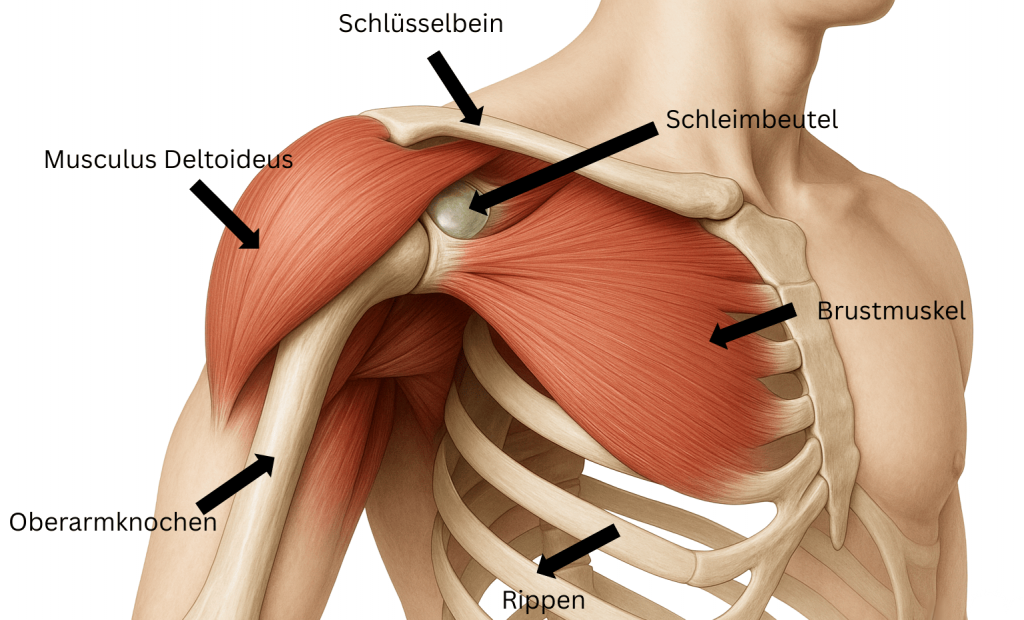
Die Schulter ist geschickt zusammengesetzt, bestehend aus einem Komplex aus nicht weniger als 4 Gelenken, nämlich:
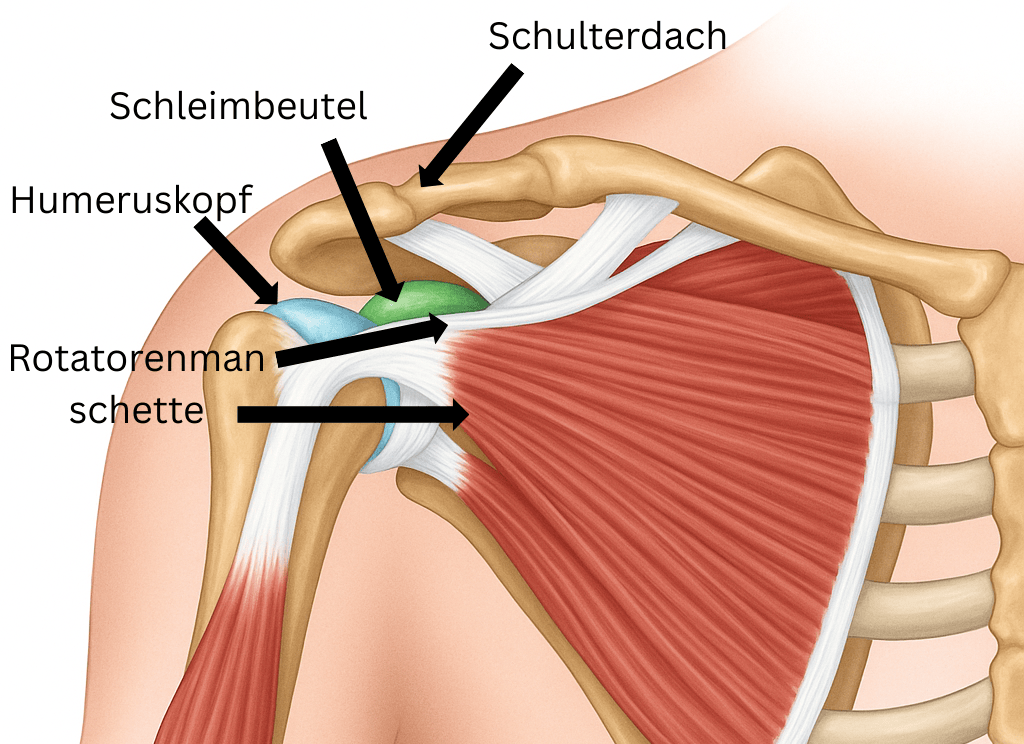
- Das Glenohumeralgelenk. Dies ist die Verbindung zwischen Oberarm und Schulterblatt. Kopf und Pfanne sind durch die Schulterkapsel, auch Rotatorenmanschette genannt, verbunden. Die Rotatorenmanschette besteht aus kleinen Muskeln, die wichtig sind, um den Schulterkopf in der Pfanne zu halten und stabilisieren..
- Das AC-Gelenk. Dies ist die Verbindung zwischen dem Schulterdach (lat.: „acromion“) und dem Schlüsselbein (lat.: „clavicula“).
- Das SC-Gelenk. Dies ist die Verbindung zwischen dem Brustbein (lat.: „sternum“) und Schlüsselbein (lat.: „clavicula“).
- Das scapulathorakale Gelenk. Dies ist die Verbindung des Schulterblatts (lat.: „scapula“) zum Brustkorb (lat.: „thorax“). Das Schulterblatt wird durch die Muskeln des oberen Rückens befestigt.
Bei einem Impingement-Syndrom der Schulter findet ein Schmerzprovokation statt, die durch Strukturen, welche sich im sogenannten „subacromialen Raum“ befinden, verursacht wird. Der subacromiale Raum ist der Raum zwischen dem Schulterdach und dem Schulterkopf (sub = unten, Acromion = Schulterdach).Obwohl dieser Raum recht klein ist – bei Männern im Durchschnitt ca. 10 mm (7-14) und bei Frauen ca. 9,5 mm (7-12)1 – befinden sich in diesem Raum dennoch ziemlich viele Strukturen. Beispiele hierfür sind die Rotatorenmanschette, der Schleimbeutel, die Bizepssehne und das Labrum (Umrahmung der Gelenkpfanne bestehend aus Knorpel).
Neue Studien zeigen jedoch, dass sich die Größe des subacromialen Raumes bei Patienten mit und ohne Schulterbeschwerden nicht unterscheidet und eine (operative) Vergrößerung dieses Raumes keinen Zusammenhang mit einer Verbesserung der Schulterschmerzen oder -funktion hat. 2
Eines der klassischsten Impingement-Symptome ist die sogenannte „Painfull Arc“. Ein Painfull Arc beschreibt eine Schmerzprovokation beim seitlichen Heben des Armes in einem Winkel von 60-120 Grad. Man geht davon aus, dass die Sehnen der Rotatorenmanschette vor allem in diesem Bereich maximal eingeklemmt werden. Studien zeigen jedoch, dass die Sehnen der Rotatorenmanschette sehr früh bei der seitlichen Armhebung unter das Schulterdach weg gleiten. Nach bereits 70 Grad Hebung ist eine Einengung folglich gar nicht mehr möglich. 3, 4
Ein weiteres und letztes Argument dafür, dass ein Impingement-Syndrom nicht die Ursache der Beschwerden erklärt, ist die Studienlage, die zeigt, dass in einer neutralen Position (Armen hängend an der Seite des Rumpfes) eine größere Kompression (Einklemmung) der Rotatorenmanschette vorliegt als bei einer seitlichen Armhebung von 90 Grad. Die Kompression in neutraler Position führt sogar zu einer stark reduzierten Durchblutung der Rotatorenmanschette (siehe Bilder). 5
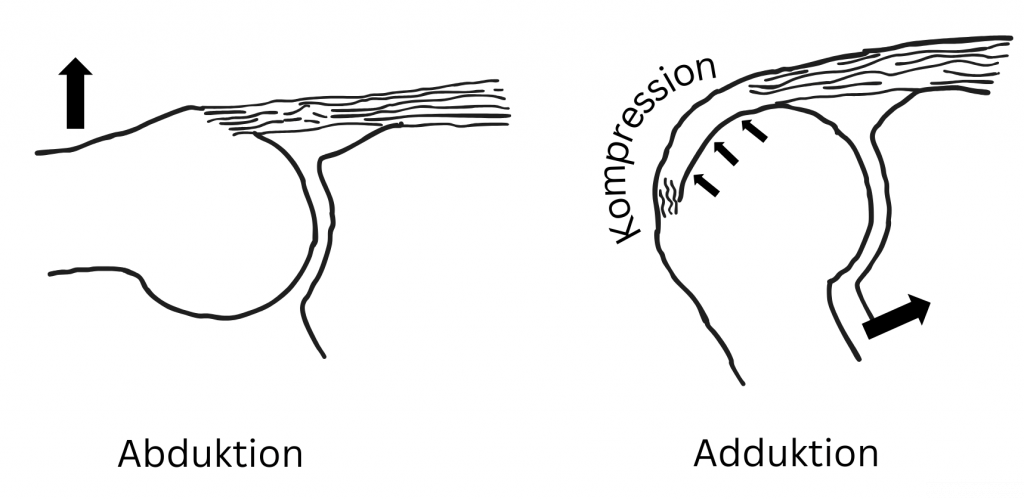
Ein Impingement-Syndrom ist keine medizinische Diagnose. Wir verwenden diesen Begriff sonst nirgends, um zu beschreiben, warum etwas weh tut. Es ist ein regulärer biomechanischer Effekt, der in vielen Bewegungsbereichen auftreten kann. So werden beispielsweise unsere Weichteile oft gequetscht oder eingeklemmt, sobald wir unsere Knie, Ellenbogen oder sogar unsere Finger beugen. An dieser Stelle behaupten wir jedoch nicht, dass ein Finger- oder Ellbogen-Impingement vorliegt, um zu erklären, warum jemand Schmerzen hat, sobald er sich bewegt.
Eine interessante Studie hat außerdem gezeigt, dass diejenigen, die einen größeren subacromialen Räum aufweisen können, stärkere und größere Rotatorenmanschettenmuskeln und -sehnen besitzen. 6 Dies kann vermutlich damit erklärt werden, dass die Gesundheit der Manschette die Größe des Raums bestimmt. Nicht umgekehrt! Je stärker und gesünder die Rotatorenmanschette ist, desto größer wird dieser Raum.
Auch wenn ein Impingement-Syndrom oder eine Einklemmung unter dem Schulterdach nun nicht die Ursache des Schmerzes darstellt, bedeutet dies nicht, dass Strukturen im subacromialen Raum keine Schmerzen auslösen können. Deswegen eignet sich der Begriff „subacromialer Schmerz“ an dieser Stelle besser. Folgende Strukturen lösen öfter Schmerzen im subacromialen Raum aus:
Die Rotatorenmanschette.
Die Rotatorenmanschette kann durch unterschiedliche Faktoren gereizt werden, was (auf Dauer) zu einer sogenannten „Tendinopathie“ der Rotatorenmanschette führen kann. Eine Tendinopathie ist eine nichtentzündliche Sehnenerkrankung, die meist degenerativ (abnutzungsbedingt), durch Überbelastung oder einer reduzierten Belastbarkeit verursacht wird. Hierbei werden die Sehnenzellen gestresst, sodass sie mehrere Moleküle (sogenannte Proteoglykanen) produzieren, welche Wasser in die Sehne ziehen. Dadurch schwillt die Sehne an und wird dicker. Dies führt zu einer Störung der Bindegewebsfasern und löst einen Reparaturprozess aus. Dabei bestehen verschiedene Faktoren, die eine Tendinopathie beeinflussen:
- Externe Faktoren wie etwa Umweltfaktoren, berufliche Faktoren, Hobbys, Sport und Traumen (aus der Vergangenheit).
- Interne Faktoren wie etwa Genetik, Fettleibigkeit, entzündliche, metabolische, endokrine und psychologische Faktoren.
Ein weiteres, relativ häufig gesehenes Phänomen der Rotatorenmanschette ist ein Riss der Rotatorenmanschette. Bei dieser Diagnose helfe, so glauben viele, letztlich nur eine Operation. Andernfalls müsse man ein Leben mit Schmerzen und einer anhaltenden Behinderung akzeptieren. Wir sind jedoch davon überzeugt, dass beides nicht der Fall sein muss.Zunächst einmal ist festzuhalten, dass Risse der Rotatorenmanschette durchaus häufiger vorkommen können. Sehr häufig sogar. Risse der Rotatorenmanschette treten häufig bei Menschen ab dem 50. Lebensjahr auf, und das oftmals ohne jegliche Symptome oder Schmerzen.7 Sie sollten demnach, genau wie Falten und graue Haare, als ein natürlicher Prozess betrachtet werden, der mit dem Altern einhergeht. Doch genau diese Erkenntnis wird Patienten dieser Altersgruppe, die an Schulterschmerzen leiden oder bereits durch eine Untersuchung einen Rotatorenmanschettenriss feststellen mussten, oft nicht erläutert. Sichtbare Manschettenrisse können schon lange vor dem Auftreten verschiedener Symptome vorhanden gewesen sein – besonders dann, wenn es keinen plötzlichen Beginn bzw. kein Trauma gibt. Daher ist es durchaus möglich, dass der Riss nicht ursächlich für die aktuellen Schmerzen und Probleme ist. Es ist auch zu vermuten, dass die Betroffenen bereits ähnliche Risse in ihren nicht schmerzhaften Schultern aufzeigen. 8
Wenn ein/e Betroffene/r allerdings erfährt, dass eine Rotatorenmanschettensehne in der Schulter gerissen ist, sind diese Worte zunächst sehr nervenaufreibend und beunruhigend und können den Patienten, je nach Schweregrad des Risses, sehr verunsichern. Um Menschen mit einem Rotatorenmanschettenriss helfen zu können, müssen wir zunächst klarstellen, dass sich unsere Sehnen durchaus unterscheiden können. Viele denken, bei unseren Sehnen handle es sich, wie bei der Achilles- oder den Fingersehnen, um seilartige Strukturen. Unsere Sehnen haben jedoch eine Vielzahl von Formen und Größen – von langen, dünnen, seilartigen über kurze, dicke und stumpfe Sehnen bis hin zu großen, flachen Sehnen, wie der Rotatorenmanschette. Die vier Sehnen der Rotatorenmanschette sind einzigartig, da sie alle miteinander verbunden sind und eine große, breite, flache, durchgehende Struktur um den Oberarmkopf bilden (siehe unteres Bild, hier rot markiert). Bei einem Riss der Rotatorenmanschette handelt es sich also um ein Loch in dieser breiten, flachen Sehne, vergleichbar mit einem Loch in einer großen Decke. Ein Loch in einer Decke bedeutet aber nicht, dass der Rest der Decke unbrauchbar ist.
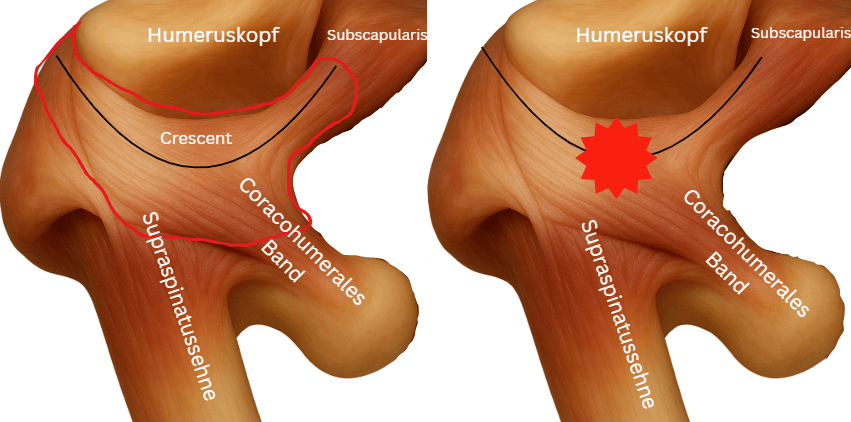
Natürlich ist auch dies immer individuell abhängig von der Größe und Lage des Lochs, doch die meisten Risse der Rotatorenmanschette treten in der Supraspinatussehne und im Halbmond (markiert mit „Crescent“ im Bild hier oben) auf. Sie lassen sich leicht ohne Operation behandeln und bringen kein Leben mit Schmerzen oder Behinderung mit sich.
Schleimbeutel befinden sich im ganzen Körper an jenen Stellen, an denen sich Muskeln und Sehnen aneinander vorbeibewegen. Ein Schleimbeutel ist ein mit Flüssigkeit gefüllter Sack, der sich zwischen Muskeln, Knochen und Sehnen ansammelt. Der Schleimbeutel sorgt dafür, dass Bewegungen möglichst reibungsarm ablaufen. In der Schulter ist der größte Schleimbeutel vergleichbar mit einem Blatt, welches zwischen den Muskeln der Rotatorenmanschette und dem oberflächlicheren Deltoideus-Muskel (große Schultermuskel) liegt.
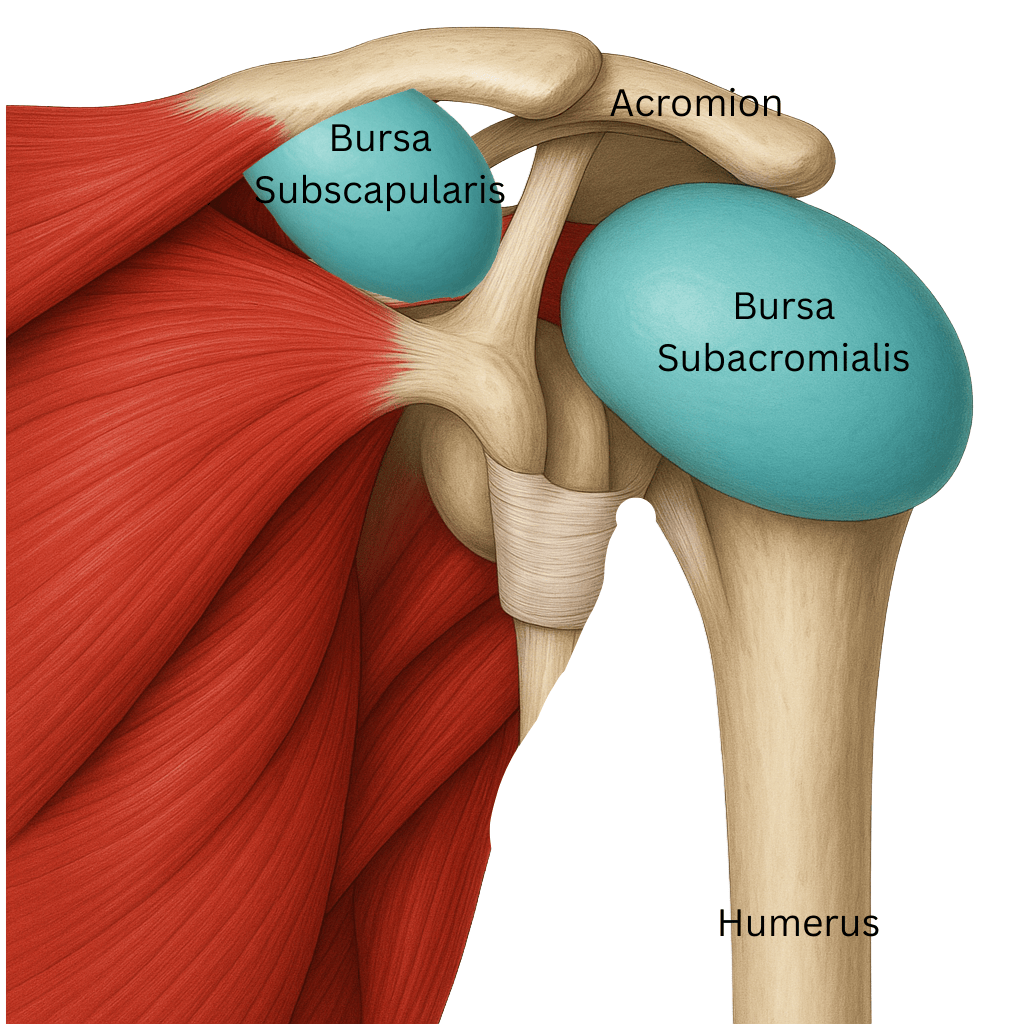
Schleimbeutel enthalten sehr viele Sensoren, die (drohende) Gewebeschäden erkennen sollen und dementsprechend eine Quelle der Schmerzen darstellen können. Durch einen Sturz auf die Schulter oder eine plötzliche Aktivitätserhöhung beim Sport oder im Alltag kann sich der Schleimbeutel entzünden.
Im Falle einer Entzündung des Schleimbeutels, schwillt dieser an. Diese Verdickung kann mittels eines Ultraschalles entdeckt werden. Studien beweisen allerdings, dass eine Verdickung oder ein Erguss des Schleimbeutels allein nicht direkt mit Schmerzen oder einer eingeschränkten Funktion einhergeht. Darüber hinaus tritt eine Bursitis (Schleimbeutelentzündung) nie allein auf 9 und es liegt meist eine Kombination von gereizten Sehnen der Rotatorenmanschette oder der Bizepssehne und einer Bursitis vor.
Den Schleimbeutel kann man an dieser Stelle mit alltäglichen Hautschwielen vergleichen. Wenn sie plötzlich viel mit den Händen machen oder eine Sportart mit einer hohen Handbelastung ausüben (z.B. Klettern oder Turnen), kann sich eine schmerzhafte Blase an den betroffenen Stellen bilden, die höllisch weh tun kann. Wenn sie die Aktivität jedoch allmählich aufbauen, kann sich eine Hautverhornung bilden, die sich schmerzlos verhärtet und belastbarer wird, um den Bereich zu schützen und gegen weitere Aktivitäten widerstandsfähig zu machen. Genau das können Schleimbeutel auch.
Oft wird eine Schleimbeutelentzündung behandelt, indem eine Kortison-Spritze gesetzt wird. Der große Nachteil hierbei ist jedoch der, dass das Kortison Sehnenzellen tötet. 10 Studien zeigen, dass eine subacromiale Kortison-Spritze nicht effektiver ist als Placebo. 11
Auch Kalkablagerungen zwischen Schulterdach und -kopf werden oftmals (mittels Röntgen oder Ultraschall) diagnostiziert. Kalkablagerungen können sich möglicherweise durch eine Kompression entwickeln und zu einer Reizung der umliegenden Strukturen führen. Allerdings zeigen Studien, dass viele Kalkablagerungen keine Symptome auslösen12 und jene, die Schmerzen auslösen, tendenziell größer und dichter sind und zudem häufiger bei Patienten mit einem hohen BMI entdeckt werden. 13
Die Schulterpfanne ist – besonders im Vergleich mit der tiefen knöchernen Hüftpfanne – sehr klein und flach. Dies muss aber auch so sein, denn unsere Schulter ist nicht umsonst so beweglich. Die Schulterpfanne wird zusätzlich durch das Labrum verstärkt. Das Labrum, auch Gelenklippe genannt, ist ein Knorpelring, der direkt an der knöchernen Schulterpfanne anliegt. Das Labrum ist wiederum mit den Muskeln der Rotatorenmanschette verbunden, die zusammen die Schulterkapsel bilden. Das Labrum erhöht die Tiefe der Gelenkpfanne und dient als Ansatz für die Sehne des langen Bizepskopfes.
Ein häufig auftretendes Labrumproblem ist die sogenannte SLAP-Läsion. SLAP ist eine Abkürzung und steht für eine Verletzung der superioren (oberen) Gelenklippe (Labrum), die von anterior nach posterior (vorne nach hinten) verläuft. Es handelt sich hierbei um einen Ab- oder Anriss am Oberrand der Gelenkpfanne.
Labrumläsionen werden meist bei Menschen ab dem 30. Lebensjahr gesehen und treten häufiger bei Männern als bei Frauen auf (Verhältnis von ca. 3:1). Sie sind jedoch nur schwierig zu diagnostizieren, da sie in 70% der Fälle nicht schmerzhaft bzw. symptomfrei sind. 14
Die Sehne des langen Bizepskopfes hat ihren Ansatz direkt am Labrum. Eine Verletzung des langen Kopfes der Bizepssehne wird nie isoliert diagnostiziert und ist ein häufiges Anzeichen für eine Rotatorenmanschetten- und/oder Labrumverletzung. 15 Eine Verletzung des langen Bizepskopfes ist ebenfalls schwierig zu diagnostizieren, da es keine Tests gibt, mit denen zuverlässig festgestellt werden kann, ob der lange Bizepskopf symptomatisch ist. 16
„Meine Körperhaltung ist verantwortlich für meine Schulterschmerzen.“
Lange wurde davon ausgegangen, dass eine „schlechte“ (nach vorne gebeugte) Körperhaltung für Schulterschmerzen verantwortlich sei. Studien zeigen, dass eine nach vorne gebeugte Körperhaltung die Überkopf-Beweglichkeit einschränkt, jedoch nicht direkt mit Schulterschmerzen einhergeht. 17
„Die (nicht-symmetrische) Bewegung meines Schulterblattes ist verantwortlich für meine Schulterschmerzen.“
Oft wird eine unzureichende oder übermäßige Beweglichkeit des Schulterblattes oder eine asymmetrische Bewegung der Schulterblätter als Ursache für Schulterschmerzen herangezogen. Viele Physiotherapeuten lernen in ihrer Ausbildung, dass ein Verhältnis von 2:1 hierbei normal ist, was bedeuten würde, dass sich beispielsweise das Schulterblatt um 60 Grad mitbewegen müsse, sobald sich der der Oberarm 120 Grad in eine bestimmte Richtung bewegt. Studien zeigen aber, dass diese Verhältnisse variabel sind und durch die folgenden Faktoren beeinflusst werden können:
- Männer haben oft höhere Verhältnisse als Frauen. 18
- Kinder haben oft höhere Verhältnisse als Erwachsene. 19
- Links- oder Rechtshänder. Die dominante Seite hat oft ein niedrigeres Verhältnis. 20
- Einseitige oder beidseitige Bewegung. Eine beidseitige Bewegung hat oft ein höheres Verhältnis als eine einseitige Bewegung. 21
- Schnellere Bewegungen haben deutlich höhere Verhältnisse als langsame Bewegungen. 22
- Schwere Bewegungen haben ein niedrigeres Verhältnis als leichte Bewegungen. 23
- Unterschiedliche Sportarten zeigen unterschiedliche Verhältnisse. 24, 25, 26
- Schmerzen können sowohl höhere als niedrigere Verhältnisse auslösen. 27, 28
Die „normale“ Schulterblattbewegung zeigt also viele unterschiedliche Variationen auf. Wir sind nicht unbedingt in der Lage, Schulterblattbewegungen und -asymmetrie zu beurteilen, es sei denn, es ist eindeutig und offensichtlich (z.B. eine Nervenläsion, bei der das Schulterblatt nicht mehr komplett angesteuert werden kann). Eine „abnormale“ oder asymmetrische Schulterblattbewegung kann genauso oft bei Menschen mit Schulterschmerzen und/oder -einschränkungen festgestellt werden als auch bei jenen ohne jegliche Beschwerden. 29, 30 Es liegen keine Beweise dafür vor, dass geringfügige Abweichungen abnormal oder gefährlich sind. Schließlich zeigen uns die Studien, dass wir die Bewegung und Beweglichkeit der Schulterblätter sowohl durch Übungen als auch durch andere Therapiearten nicht verändern können. 31, 32
Obwohl bekannt ist, dass bei Menschen eine große anatomische Variation besteht, wird diese Variation oft und fälschlicherweise als Ursache für bestimmte Symptome gesehen:
- Wie schon erwähnt, wird der Raum zwischen dem Schulterdach und dem Schulterkopf häufig als Ursache für die Beschwerden herangezogen. Studien zeigen jedoch, dass dieser Raum nicht in Verbindung Schmerzen oder einer eingeschränkten Funktion steht. 33 Oft versucht man den Raum zwischen dem Schulterdach und -kopf mit einer sogenannten Dekompressionsoperation zu vergrößern. Obwohl diese Operationsart eine gemeldete Erfolgsquote von 80% hat, 34 zeigen Studien, dass sie nicht effektiver ist als eine Placebo-Operation. 35 Selbst wenn der (zu kleine) Raum zwischen dem Schulterdach und -kopf für die Schulterschmerzen auschlaggebend wäre, müsste man dies nicht operativ lösen da wir wissen, dass eine gut trainierte Rotatorenmanschette in Verbindung mit einem größeren Subacromialraum steht. Durch ein gezieltes Training der Rotatorenmanschette kann man den Raum also wahrscheinlich „größer“ machen.
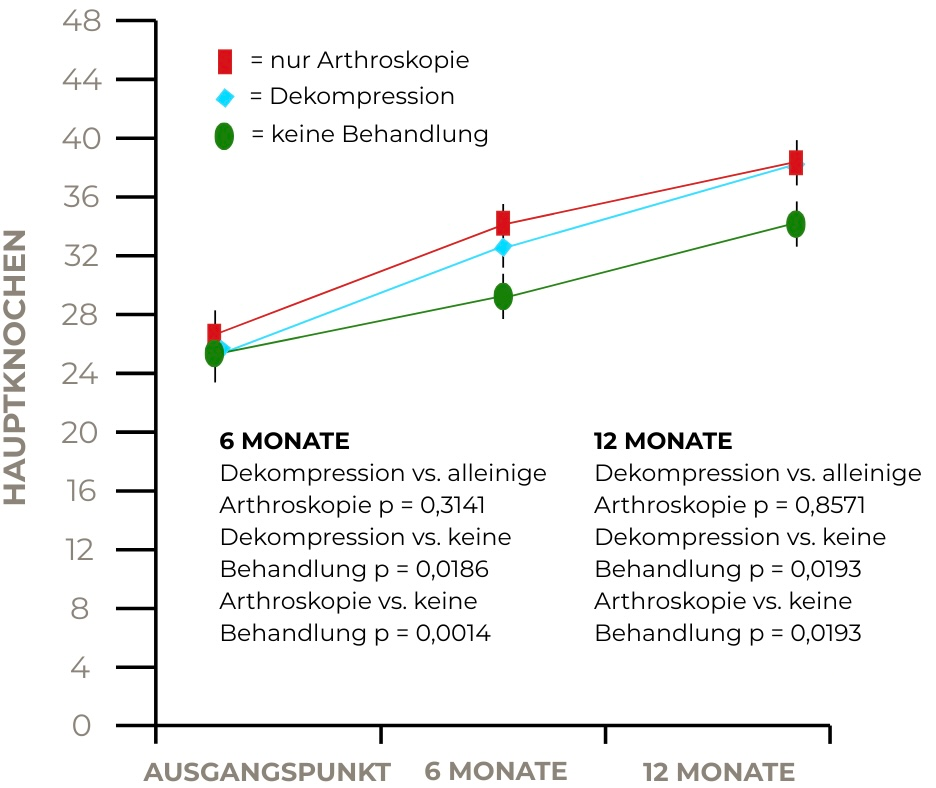
In dieser Studie wurden 313 Probanden mit einem „Impingement“ verfolgt wobei eine Dekompressionsoperation verglichen wurde mit einer Gelenkspiegelung (Scheinoperation wobei keine Strukturen operiert oder entfernt wurden) und keine Behandlung. Zwischen den beiden Operationsarten wurden keine Unterschiede gefunden und die Unterschiede zwischen den Operationen und keine Behandlung waren klinisch nicht von Bedeutung.
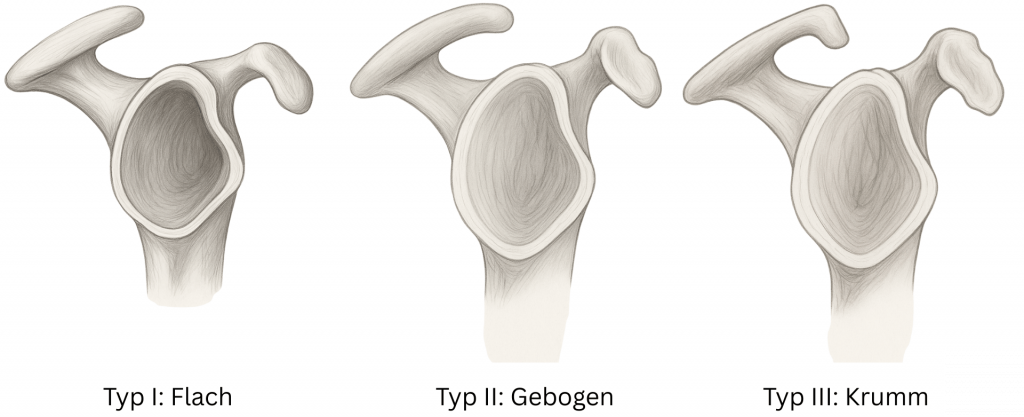
Zudem wird oft auch der Winkel des Schulterdaches als Ursache für die Schulterbeschwerden angesehen. Dieser wird, vor allem bei Typ II und III (siehe Bild), durch eine Operation korrigiert. Studien zeigen allerdings, dass der Winkel des Schulterdaches nicht in Verbindung mit Pathologien der Rotatorenmanschette steht. 36
Risse der Rotatorenmanschette treten an unterschiedlichen Stellen und in unterschiedlichem Schweregrad auf. Bei größeren Rissen (>1cm), die 2 oder mehr Sehnen betreffen, wird davon ausgegangen, dass die Reha-Ergebnisse schlechter ausfallen. Allerdings gibt besteht auch hier keine direkte Verbindung zwischen den Schulterschmerzen / -behinderungen und der Größe oder dem Ort des Risses. 37Eine direkte Verbindung sehen wir jedoch bei dem Gesundheitszustand, dem Bildungsniveau und der Selbstwirksamkeit des Patienten und seinen Schulterschmerzen und -behinderungen. 38 Demnach gibt es viele andere Faktoren, die zu berücksichtigen sind, bevor eine Operation in Erwägung gezogen wird:
- BMI/Adipositas
- Diabetes
- Rauchen/Alkohol
- Stress und Depressionen
- Aktivitätsniveau
- Sozioökonomisches Niveau
Diese Erkenntnis bringt uns zu der Frage, wann man eine operative Behandlung überhaupt in Betracht ziehen sollte. Um dies zu tun, müssen starke Schulterschmerzen und eine plötzlich auftretende Behinderung vorliegen. Der Riss muss durch einen Scan bestätigt werden und über 1,5 cm groß sein. Zudem sollte er 2 oder mehr Sehnen betreffen. Trotz Ruhe- und/oder Reha-Maßnahmen sollten innerhalb von 3 Monaten keine Verbesserungen zu erkennen sein. Weitere Faktoren und Symptome sind starke nächtliche Schmerzen und/oder ein körperlich anstrengender Beruf oder Sport. Der Patient ist zudem bei guter Gesundheit, weist geringe Risikofaktoren auf und ist sich der Risiken und Reha-Zeit bewusst.
Wie bei jedem unserer (neuen) Patienten, erwartet sie zu Beginn der ersten Therapiesitzung ein ausführliches Anamnesegespräch mit einem unserer Therapeuten, um für die Therapie relevante Information zu evaluieren und mögliche Kontraindikationen oder sogenannte „Red Flags“ auszuschließen. Danach wird eine gründliche Untersuchung durch den Therapeuten vorgenommen, um den aktuellen Rehabilitationsstand genauestens festlegen zu können.
Zudem wird gemeinsam mit dem Patienten ein individuelles Anforderungsprofil erstellt, welches speziell auf die täglichen Anforderungen im Leben des Patienten abgestimmt ist. Ziel ist es, einen klar objektiv definierten IST-Standpunkt zu gestalten und mittels erster Planungen den zu erreichenden Soll-Stand zu formulieren. Dieser Weg wird durch den Transfer der Therapie stattfinden und laufend neu motorisiert und evaluiert, um zu jedem Zeitpunkt über den aktuellen Leistungszustand des Patienten informiert zu sein.
Um diese Art der Methodik noch effizienter zu gestalten und das volle Potenzial aus der Behandlung schöpfen zu können, bieten wir ihnen optional die Möglichkeit der erweiterten Therapiezeit an. Ziel dieser Zusatzleistung ist es, unser Behandlungspotential voll auszuschöpfen, eine qualitativ hochwertige Therapie zu garantieren und damit das Therapieergebnis zu optimieren. Durch das erweiterte Konzept können unsere Therapeuten deshalb noch effizienter an dem Therapieprozess arbeiten.
Wie bereits erwähnt, gibt es mehrere Probleme, die sich im subakromialen Bereich bemerkbar machen können (wichtig zu erwähnen ist, dass wir nicht alle, sondern nur die häufigsten Probleme beschrieben haben). Hierfür gibt es keine „One-Size-Fits-All-Lösung“, denn jedes Problem bedingt einen individuellen Ansatz. Trotzdem gibt es bestimmte Basisansätze, die zu jeder Zeit einen festen Bestandteil der Therapie ausmachen. Zuerst werden wir sie, auch mittels dieser Seite, darüber informieren und beraten, was ihr Problem genau beinhaltet, wie man optimalerweise damit umgehen soll und welche möglichen Fragen oder Unsicherheiten wir im Vorhinein gemeinsam klären können.
Zunächst werden wir bei jeglicher Problematik versuchen, die Aktivität sowohl im Alltag als auch während der Therapie, so gut es geht zu stimulieren. Ziel hierbei ist es die Beweglichkeit und Belastbarkeit aufzubauen und damit die Schmerzen zu reduzieren. Darüber hinaus haben wir durch diesen Ansatz einen positiven Einfluss auf mögliche Ängste und auf das Selbstvertrauen, womit wir die Schmerzen und die Beweglichkeit zusätzlich positiv beeinflussen können.
Darüber hinaus prüfen wir, ob es Faktoren gibt, die die Regeneration behindern. Hierfür gibt es lokale und allgemeine Faktoren, die sowohl eine positive als auch eine negative Rolle spielen können. Beispiele von lokalen Faktoren sind eine eingeschränkte Beweglichkeit des Schultergürtels und/oder des oberen Rückens. Beispiele von allgemeinen Faktoren sind die allgemeine Gesundheit, der Ernährungszustand, der Regenerationszustand und mögliche Entzündungsfaktoren. Eine passive Therapie, zum Beispiel in Form von Massage, manueller Therapie oder Osteopathie, wird eher selten eingesetzt, kann aber in Form von einer Zusatztherapie als ein Mehrwert dienen.
Werfen wir uns noch einmal einen Blick auf die Strukturen, die oft für subacromiale Schmerzen verantwortlich sind.
Die Rotatorenmanschette. Was die Rotatorenmanschette betrifft, gibt es mehrere mögliche Probleme, die von einer „einfachen“ Reizung bis hin zu einer Tendinopathie oder einem Sehnenriss variieren können. Je nach Problem gibt es demnach auch eine (leicht) variierende Vorgehensweise. Wichtig bei allen Behandlungsansätzen ist aber, dass die Rotatorenmanschette gezielt trainiert wird. Hierdurch stimulieren wir die Durchblutung, erhöhen die Belastbarkeit und reduzieren mögliche Bewegungseinschränkungen, Schmerzen und/oder Ängste. 39, 40, 41
Sowohl zu der Rotatorenmanschette als auch dessen Training bestehen einige Missverständnisse. Oft wird bei einem Training der Rotatorenmanschette ein Fokus auf Außenrotationsübungen gelegt, da die Rotatorenmanschette uns diese Bewegung (mit) ermöglicht. Die Hauptfunktion der Rotatorenmanschette ist aber die Zentrierung des Oberarmknochens in der Gelenkpfanne des Schultergelenks. Dementsprechend ist sie auch bei der (seitlichen) Armhebung und Armstreckung aktiv. 42 Es gibt nicht die eine, beste Übung für die Rotatorenmanschette. Es ist aber wichtig, alle Schulterbewegungen mit in der Therapie / im Trainingsplan einzubauen. Beispiele hierzu sind Front- und Seitheben, Schulter- und Bankdrücken, Überzüge und Rudern. Mit der Zeit sollte der Bewegungsbereich, die Belastung und die Geschwindigkeit weiter aufgebaut werden.
Viele Patienten mit einem Rotatorenmanschettenriss sind besorgt, dass der Riss größer wird, wenn sie die Schulter bewegen. Bewegung und Training können aber dazu beitragen, dass die Funktion und Elastizität der restlichen Decke, die um das Loch herum liegt, verbessert wird. Dies führt zu einer verbesserten Beweglichkeit und einer Reduktion der Schmerzen. Es gibt kaum Beweise dafür, dass sich ein Rotatorenmanschettenriss durch Bewegung verschlechtert oder vergrößert. 43
Bewegung und Training bei Sehnenrissen können ebenso helfen, indem sie andere kognitive und psychologische Aspekte zur Schmerzreduzierung und Funktionsverbesserung beeinflussen, wie zum Beispiel die Verringerung von Ängsten und die Stärkung des Selbstvertrauens. 44, 45
Schleimbeutel. Wir sagen es nicht oft, aber bei Beschwerden in der Schulter, die auf eine Schleimbeutelentzündung hindeuten, wird (am Anfang) Ruhe empfohlen, Überkopfbewegungen vorübergehend zu vermeiden und zu versuchen, nicht auf der betroffenen Seite zu liegen. Erinnern sie sich nochmal an das Hautschwielen-Beispiel. Wenn die Schleimbeutel akut gereizt ist und eine „Blase“ entsteht, braucht es zunächst etwas Zeit und Ruhe, damit sich das Gewebe wieder regeneriert.
Schleimbeutel sind adaptive Gewebe (wie alle anderen Gewebe), das bedeutet sie reagieren auf Aktivität und Kräfte, die auf sie einwirken. Bauen sie allmählich Aktivität auf können sich die Schleimbeutel schmerzlos anpassen. Wenn sie zu schnell zu viel tun, führt dies oftmals zu Schmerzen.
Eine Studie zeigte dies bei Schwimmern. In dieser Studie sind die Schulterschleimbeutel untersucht worden, während die Schwimmer ihr Schwimmvolumen erhöhten. Mehr Schwimmen führte dabei zu einem dickeren Schleimbeutel, hier gab es aber keine Verbindung zu Schulterschmerzen! 46
Nach einer Ruhephase müssen wir durch ein gezieltes Training und Coaching die Schulteraktivität langsam erhöhen damit wir, wie bei den Schwimmern, „Schwielen“ bilden. Hierdurch erhöhen wir die Belastbarkeit der Schleimbeutel und können zukünftige Probleme vorbeugen. Darüber hinaus prüfen wir, ob es Faktoren gibt, die die Regeneration behindern, wie eine eingeschränkte Beweglichkeit des Schultergürtels und/oder des oberen Rückens. Nach der Akutphase können wir beurteilen, ob ein Kraftdefizit besteht, welches durch ein gezieltes Training behoben werden muss.
QUELLENANGABE
- Habermeyer P: Schulterchirurgie. München: Elsevier, Urban & Fischer 2010; 4th edition.
- Park, S. W., Chen, Y. T., Thompson, L., Kjoenoe, A., Juul-Kristensen, B., Cavalheri, V., & McKenna, L. (2020). No relationship between the acromiohumeral distance and pain in adults with subacromial pain syndrome: a systematic review and meta-analysis. Scientific Reports, 10(1), 1-14.
- Mehta, S., Gimbel, J. A., & Soslowsky, L. J. (2003). Etiologic and pathogenetic factors for rotator cuff tendinopathy. Clinics in sports medicine, 22(4), 791-812.
- Giphart, J. E., van der Meijden, O. A., & Millett, P. J. (2012). The effects of arm elevation on the 3-dimensional acromiohumeral distance: a biplane fluoroscopy study with normative data. Journal of shoulder and elbow surgery, 21(11), 1593-1600.
- Rathbun, J. B., & Macnab, I. (1970). The microvascular pattern of the rotator cuff. The Journal of bone and joint surgery. British volume, 52(3), 540-553.
- Schmidt et al (2021) Sports Bas
- Teunis, T., Lubberts, B., Reilly, B. T., & Ring, D. (2014). A systematic review and pooled analysis of the prevalence of rotator cuff disease with increasing age. Journal of shoulder and elbow surgery, 23(12), 1913-1921.
- Barreto, R. P. G., Braman, J. P., Ludewig, P. M., Ribeiro, L. P., & Camargo, P. R. (2019). Bilateral magnetic resonance imaging findings in individuals with unilateral shoulder pain. Journal of shoulder and elbow surgery, 28(9), 1699-1706.
- Dean, B. J. F., Gwilym, S. E., & Carr, A. J. (2013). Why does my shoulder hurt? A review of the neuroanatomical and biochemical basis of shoulder pain. British journal of sports medicine, 47(17), 1095-1104.
- Dean, B. J. F., Franklin, S. L., Murphy, R. J., Javaid, M. K., & Carr, A. J. (2014). Glucocorticoids induce specific ion-channel-mediated toxicity in human rotator cuff tendon: a mechanism underpinning the ultimately deleterious effect of steroid injection in tendinopathy?. British journal of sports medicine, 48(22), 1620-1626.
- Mohamadi, A., Chan, J. J., Claessen, F. M., Ring, D., & Chen, N. C. (2017). Corticosteroid injections give small and transient pain relief in rotator cuff tendinosis: a meta-analysis. Clinical Orthopaedics and Related Research®, 475(1), 232-243.
- Le Goff, B., Berthelot, J. M., Guillot, P., Glémarec, J., & Maugars, Y. (2010). Assessment of calcific tendonitis of rotator cuff by ultrasonography: comparison between symptomatic and asymptomatic shoulders. Joint Bone Spine, 77(3), 258-263.
- Le Goff, B., Berthelot, J. M., Guillot, P., Glémarec, J., & Maugars, Y. (2010). Assessment of calcific tendonitis of rotator cuff by ultrasonography: comparison between symptomatic and asymptomatic shoulders. Joint Bone Spine, 77(3), 258-263.
- Schwartzberg, R., Reuss, B. L., Burkhart, B. G., Butterfield, M., Wu, J. Y., & McLean, K. W. (2016). High prevalence of superior labral tears diagnosed by MRI in middle-aged patients with asymptomatic shoulders. Orthopaedic journal of sports medicine, 4(1), 2325967115623212.
- Hanusch, B. C., Makaram, N., Utrillas-Compaired, A., Lawson-Smith, M. J., & Rangan, A. (2016). Biceps sheath fluid on shoulder ultrasound as a predictor of rotator cuff tear: analysis of a consecutive cohort. Journal of Shoulder and Elbow Surgery, 25(10), 1661-1667.
- Hegedus, E. J., Goode, A. P., Cook, C. E., Michener, L., Myer, C. A., Myer, D. M., & Wright, A. A. (2012). Which physical examination tests provide clinicians with the most value when examining the shoulder? Update of a systematic review with meta-analysis of individual tests. British journal of sports medicine, 46(14), 964-978.
- Barrett, E., O’Keeffe, M., O’Sullivan, K., Lewis, J., & McCreesh, K. (2016). Is thoracic spine posture associated with shoulder pain, range of motion and function? A systematic review. Manual therapy, 26, 38-46.
- Nagamatsu, T., Kai, Y., Gotoh, M., Madokoro, K., & Shiba, N. (2015). Effects of sex differences on scapular motion during arm elevation. SICOT-J, 1.
- Habechian, F. A., Fornasari, G. G., Sacramento, L. S., & Camargo, P. R. (2014). Differences in scapular kinematics and scapulohumeral rhythm during elevation and lowering of the arm between typical children and healthy adults. Journal of Electromyography and Kinesiology, 24(1), 78-83.
- Matsuki, K., Matsuki, K. O., Mu, S., Kenmoku, T., Yamaguchi, S., Ochiai, N., … & Banks, S. A. (2014). In vivo 3D analysis of clavicular kinematics during scapular plane abduction: comparison of dominant and non-dominant shoulders. Gait & Posture, 39(1), 625-627.
- Klopčar, N., & Lenarčič, J. (2006). Bilateral and unilateral shoulder girdle kinematics during humeral elevation. Clinical Biomechanics, 21, S20-S26.
- Sugamoto, K., Harada, T., Machida, A., Inui, H., Miyamoto, T., Takeuchi, E., … & Ochi, T. (2002). Scapulohumeral rhythm: relationship between motion velocity and rhythm. Clinical Orthopaedics and Related Research®, 401, 119-124.
- McQuade, K. J., & Smidt, G. L. (1998). Dynamic scapulohumeral rhythm: the effects of external resistance during elevation of the arm in the scapular plane. Journal of Orthopaedic & Sports Physical Therapy, 27(2), 125-133.
- Silva, R. T., Hartmann, L. G., de Souza Laurino, C. F., & Biló, J. R. (2010). Clinical and ultrasonographic correlation between scapular dyskinesia and subacromial space measurement among junior elite tennis players. British journal of sports medicine, 44(6), 407-410.
- Roseborrough, A., & Lebec, M. (2007). Differences in static scapular position between rock climbers and a non-rock climber population. North American Journal of Sports Physical Therapy: NAJSPT, 2(1), 44.
- Pellegrini, A., Tonino, P., Paladini, P., Cutti, A., Ceccarelli, F., & Porcellini, G. (2013). Motion analysis assessment of alterations in the scapulo-humeral rhythm after throwing in baseball pitchers. Musculoskeletal surgery, 97(1), 9-13.
- Struyf, F., Nijs, J., Baeyens, J. P., Mottram, S., & Meeusen, R. (2011). Scapular positioning and movement in unimpaired shoulders, shoulder impingement syndrome, and glenohumeral instability. Scandinavian journal of medicine & science in sports, 21(3), 352-358.
- Wassinger, C. A., Sole, G., & Osborne, H. (2013). Clinical measurement of scapular upward rotation in response to acute subacromial pain. journal of orthopaedic & sports physical therapy, 43(4), 199-203.
- Lukasiewicz, A. C., McClure, P., Michener, L., Pratt, N., & Sennett, B. (1999). Comparison of 3-dimensional scapular position and orientation between subjects with and without shoulder impingement. Journal of Orthopaedic & Sports Physical Therapy, 29(10), 574-586.
- Plummer, H. A., Sum, J. C., Pozzi, F., Varghese, R., & Michener, L. A. (2017). Observational scapular dyskinesis: known-groups validity in patients with and without shoulder pain. journal of orthopaedic & sports physical therapy, 47(8), 530-537.
- McQuade, K. J., Borstad, J., & de Oliveira, A. S. (2016). Critical and theoretical perspective on scapular stabilization: what does it really mean, and are we on the right track?. Physical therapy, 96(8), 1162-1169.
- Hotta, G. H., de Assis Couto, A. G., Cools, A. M., McQuade, K. J., & de Oliveira, A. S. (2020). Effects of adding scapular stabilization exercises to a periscapular strengthening exercise program in patients with subacromial pain syndrome: A randomized controlled trial. Musculoskeletal Science and Practice, 49, 102171.
- Navarro-Ledesma, S., Struyf, F., Labajos-Manzanares, M. T., Fernandez-Sanchez, M., Morales-Asencio, J. M., & Luque-Suarez, A. (2017). Does the acromiohumeral distance matter in chronic rotator cuff related shoulder pain?. Musculoskeletal Science and Practice, 29, 38-42.
- Lewis, J. S. (2011). Subacromial impingement syndrome: a musculoskeletal condition or a clinical illusion?. Physical Therapy Reviews, 16(5), 388-398.
- Beard, D. J., Rees, J. L., Cook, J. A., Rombach, I., Cooper, C., Merritt, N., … & Woods, D. (2018). Arthroscopic subacromial decompression for subacromial shoulder pain (CSAW): a multicentre, pragmatic, parallel group, placebo-controlled, three-group, randomised surgical trial. The Lancet, 391(10118), 329-338.
- Chalmers, P. N., Salazar, D., Steger-May, K., Chamberlain, A. M., Yamaguchi, K., & Keener, J. D. (2017). Does the critical shoulder angle correlate with rotator cuff tear progression?. Clinical Orthopaedics and Related Research®, 475(6), 1608-1617.
- Unruh, K. P., Kuhn, J. E., Sanders, R., An, Q., Baumgarten, K. M., Bishop, J. Y., … & MOON Shoulder Group. (2014). The duration of symptoms does not correlate with rotator cuff tear severity or other patient-related features: a cross-sectional study of patients with atraumatic, full-thickness rotator cuff tears. Journal of shoulder and elbow surgery, 23(7), 1052-1058.
- Unruh, K. P., Kuhn, J. E., Sanders, R., An, Q., Baumgarten, K. M., Bishop, J. Y., … & MOON Shoulder Group. (2014). The duration of symptoms does not correlate with rotator cuff tear severity or other patient-related features: a cross-sectional study of patients with atraumatic, full-thickness rotator cuff tears. Journal of shoulder and elbow surgery, 23(7), 1052-1058.
- Holmgren, T., Hallgren, H. B., Öberg, B., Adolfsson, L., & Johansson, K. (2012). Effect of specific exercise strategy on need for surgery in patients with subacromial impingement syndrome: randomised controlled study. Bmj, 344.
- Kuhn, J. E., Dunn, W. R., Sanders, R., An, Q., Baumgarten, K. M., Bishop, J. Y., … & MOON Shoulder Group. (2013). Effectiveness of physical therapy in treating atraumatic full-thickness rotator cuff tears: a multicenter prospective cohort study. Journal of shoulder and elbow surgery, 22(10), 1371-1379.
- Saltychev, M., Äärimaa, V., Virolainen, P., & Laimi, K. (2015). Conservative treatment or surgery for shoulder impingement: systematic review and meta-analysis. Disability and rehabilitation, 37(1), 1-8.
- Wattanaprakornkul, D., Cathers, I., Halaki, M., & Ginn, K. A. (2011). The rotator cuff muscles have a direction specific recruitment pattern during shoulder flexion and extension exercises. Journal of science and medicine in sport, 14(5), 376-382.
- Kong, B. Y., Cho, M., Lee, H. R., Choi, Y. E., & Kim, S. H. (2018). Structural evolution of nonoperatively treated high-grade partial-thickness tears of the supraspinatus tendon. The American Journal of Sports Medicine, 46(1), 79-86.
- Nijs, J., Girbés, E. L., Lundberg, M., Malfliet, A., & Sterling, M. (2015). Exercise therapy for chronic musculoskeletal pain: innovation by altering pain memories. Manual therapy, 20(1), 216-220.
- Littlewood, C., Malliaras, P., & Chance-Larsen, K. (2015). Therapeutic exercise for rotator cuff tendinopathy: a systematic review of contextual factors and prescription parameters. International Journal of Rehabilitation Research, 38(2), 95-106.
- Couanis, G., Breidahl, W., & Burnham, S. (2015). The relationship between subacromial bursa thickness on ultrasound and shoulder pain in open water endurance swimmers over time. Journal of Science and Medicine in Sport, 18(4), 373-377.