Der Begriff „Frozen Shoulder“ ist zum ersten Mal in der 1940’er Jahren benutzt worden. Angenommen wurde, dass die Gelenkkapsel sich am Oberarmkopf verwachsen hat. Heutzutage wissen wir, dass es bei Patienten mit einem Frozen Shoulder keine Verwachsungen gibt. 1 Bei einem Frozen Shoulder sehen wir eine sogenannte Angiogenese (Entstehung neuer Blutgefäße aus vorbestehenden Blutgefäßen) der Gelenkkapsel. Dieser Prozess führt zu einer erhöhten Produktion, Desorganisation und Kontrakturen der Bindegewebsfasern im Schulterkapsel. 2 Dies führt zu einer stark eingeschränkten Beweglichkeit und viele Schmerzen und das leider für eine lange Zeit. Auf dieser Seite erfahren sie alles zu der Entstehung, die Symptome und unserer Vorgehensweise bei der Diagnose „Frozen Shoulder“.

Die Schulter ist geschickt zusammengesetzt. Es ist ein Komplex aus nicht weniger als 4 Gelenken, nämlich:
- Das Glenohumeralgelenk. Dies ist die Verbindung zwischen Oberarm und Schulterblatt. Kopf und Pfanne sind durch die Schulterkapsel, auch Rotatorenmanschette genannt, verbunden. Kleine Muskeln, die extrem wichtig sind, um den Schulterkopf in der Pfanne zu halten.
- Das AC-Gelenk. Dies ist die Verbindung zwischen dem Schulterdach (Acromion auf Latein) und Schlüsselbein (Clavicula auf Latein).
- Das SC-Gelenk. Dies ist die Verbindung zwischen dem Brustbein (Sternum auf Latein) und Schlüsselbein (Clavicula auf Latein).
- Das scapulathorakale Gelenk. Dies ist die Verbindung des Schulterblatts (Scapula auf Latein) zum Brustkorb (Thorax auf Latein). Das Schulterblatt ist durch Muskeln am oberen Rücken befestigt.
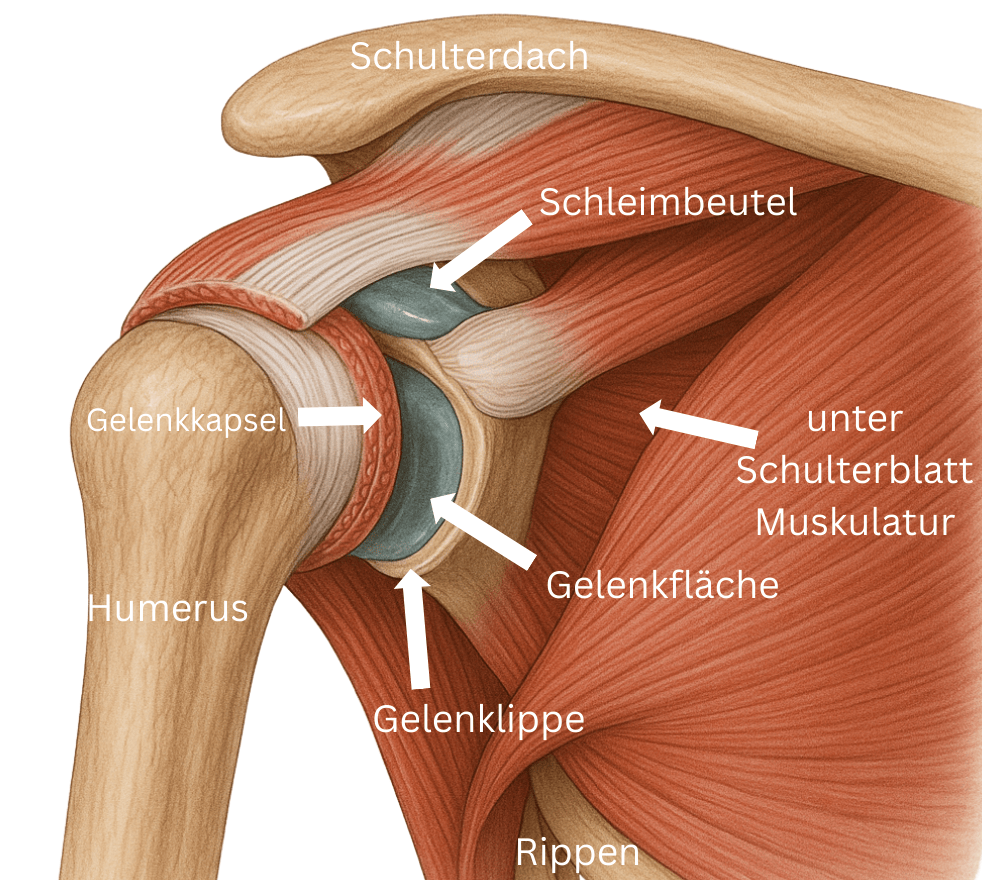
Bei einer Frozen Shoulder handelt es sich um die Gelenkkapsel (gelb markiert auf dem Bild hier unten). Die Gelenkkapsel umhüllt das Glenohumeralgelenk das den Oberarmknochen mit dem Schulterblatt verbindet.
Frozen Shoulders treten bei 2-5% der Allgemeinbevölkerung auf und sehen wir häufiger bei Frauen (Verhältnis Frau – Mann liegt ungefähr bei 3:1). Frozen Shoulders werden primär und sekundär kategorisiert. Eine primäre Frozen Shoulder ist eine eigenständige Erkrankung, die sich auf keine bestehende Grunderkrankung zurückführen lässt. Eine sekündare Frozen Shoulder sehen wir in Folge von anderen Erkrankungen, Verletzungen oder Operationen im Schulterbereich. 3, 4
Sekundäre Frozen Shoulders werden unterteilt in drei verschiedenen Kategorien:
- Systemisch: hierzu gehören metabolischen Krankheiten wie Diabetes, endokrine Krankheiten an z.B. der Schilddrüse, Herz-Kreislauf-Krankheiten, entzündliche Krankheiten und genetische Einflüsse.
- Extrinsisch: hierzu gehören eine geringe körperliche Aktivität, zervikale Radikulopathie (Reizung oder Schädigung einer Nervenwurzel in der Halswirbelsäule) oder einen Schlaganfall.
- Intrinsisch: hierzu gehören Schultertraumas, Schulteroperationen, eine Pathologie der Rotatorenmanschette und Schultergelenksinfektionen.
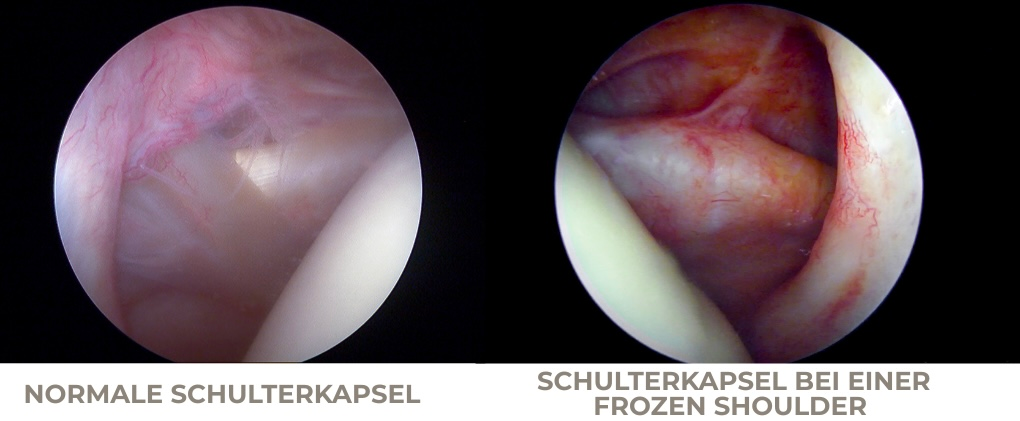
Eine Frozen Shoulder ist leider einer der schlimmsten Schulterdiagnosen. Über eine durchschnittliche Dauer von 30 Monaten produziert sie viele Schmerzen und große Bewegungseinschränkungen. Der Verlauf einer Frozen Shoulder wird in drei Phasen unterteilt: 5
- Eine „Freezing-Phase“: Schmerzen stehen im Vordergrund, sekundär kommt die Bewegungseinschränkung.
- Eine „Frozen-Phase“: Die Bewegungseinschränkung steht im Vordergrund, sekundär kommen die Schmerzen.
- Eine „Thawing-Phase“: hier merkt man, dass beide langsam besser werden.
Während der Anamnese sehen wir oft folgende Faktoren und/oder Symptome bei Patienten mit einem Frozen Shoulder:
- Frozen Shoulders sehen wir häufigsten bei Personen um die 50 Jahren alt.
- Die Entstehung kann sowohl spontan als allmählich anfangen.
- Schmerzen sind oft ständig da und sehr intensiv. Eine Schmerzproduktion findet vor allem bei plötzlicher Bewegung statt.
- Der Schmerz ist weit verbreitet (von der Schulter bis zur Hand), diffus und es gibt große Einschränkungen im Alltag.
- Eine Schmerzlinderung ist sehr schwer und oft nicht möglich.
Bei der Körperlichen Untersuchung ist ein signifikanter Bewegungsverlust in der aktiven (der Patient bewegt den Arm selbst) und passiven Beweglichkeit (der Therapeut bewegt den Arm des Patienten) zu sehen. Widerstand ist allerdings oft (relativ) schmerzfrei möglich im schmerzfreien Bereich (vor allem die Außenrotation ist oft gut möglich). Um eine Frozen Shoulder zu diagnostizieren ist eine bildgebende Untersuchung in Form von Röntgen, MRT oder CT notwendig um Arthrose, Arthritis oder andere mögliche Ursachen auszuschließen.
„Bei einer Frozen Shoulder soll / darf ich meine Schulter nicht belasten.“
Obwohl bei einer Frozen Shoulder starke Schmerzen und Bewegungseinschränkungen da sind, ist eine Entlastung oder Schonung nicht zu empfehlen, denn nur durch eine gezielte, schmerzfreie Belastung kann man die Beweglichkeit und auch die Schmerzen positiv beeinflussen. Jede Art von (dauerhafte) Entlastung oder Schonung sorgt dafür, dass die Beweglichkeit schlecht bleibt oder noch schlechter wird.
„Bei einer Frozen Shoulder soll ich mich oft dehnen.“
Bei einer (stark) eingeschränkte Beweglichkeit denkt man oft, dass man Dehnen soll. Zum Thema Dehnen gibt es viele Missverständnisse, denn die Verbesserung der Beweglichkeit (die man nur erreicht, indem man sich extrem viel dehnt), 6 wird durch eine Veränderung des Nervensystems verursacht die zu einer erhöhten Schmerztoleranz führt, nicht durch eine Veränderung auf muskuläre oder bindegewebs-ebene. Studien zeigen, dass regelmäßige Dehnübungen des Unterkörpers zu einer erhöhten Beweglichkeit im Oberkörper führt und andersrum. 7
Wir wissen, dass Muskulatur dynamisches Gewebe ist und sich anpassen kann. Es kann sich tatsächlich verlängern und verkürzen. Das klassische Dehnen ist aber keine optimale Methode, um dies zu erreichen.
„Bei einer Frozen Shoulder soll ich mich oft dehnen.“
Bei einer (stark) eingeschränkte Beweglichkeit denkt man oft, dass man Dehnen soll. Zum Thema Dehnen gibt es viele Missverständnisse, denn die Verbesserung der Beweglichkeit (die man nur erreicht, indem man sich extrem viel dehnt), 6 wird durch eine Veränderung des Nervensystems verursacht die zu einer erhöhten Schmerztoleranz führt, nicht durch eine Veränderung auf muskuläre oder bindegewebs-ebene. Studien zeigen, dass regelmäßige Dehnübungen des Unterkörpers zu einer erhöhten Beweglichkeit im Oberkörper führt und andersrum. 7
Wir wissen, dass Muskulatur dynamisches Gewebe ist und sich anpassen kann. Es kann sich tatsächlich verlängern und verkürzen. Das klassische Dehnen ist aber keine optimale Methode, um dies zu erreichen.
„Bei einer Frozen Shoulder soll ich mich passiv behandeln lassen.“
Eine passive Behandlung (in Form von Massage oder manuelle Therapie) kann in der ersten („freezing“) Phase, wo Schmerzen stark im Vordergrund stehen, angewandt werden, um Schmerzen zu reduzieren. Diese Art von Therapie soll aber nur kurzfristig angewandt werden da sie keinen Einfluss auf die Ursache des Problems und die Beweglichkeit ausübt. Darüber hinaus zeigen Studien, dass die Ergänzung eines Trainings-/Übungsprogramms durch passive Therapie in Form von Massage oder manuelle Therapie, die Ergebnisse nicht verbessert. 8, 9
Konservative Behandlungen in Form von Physiotherapie, Bewegung und, wenn nötig, Schmerzmittel führen bei bis zu 90% der Patienten mit einer Frozen Shoulder zum Erfolg. 10 Eine Operation bei einer Frozen Shoulder soll nur als letztes Mittel eingesetzt werden, wenn alles andere, nach minimal 3-6 Monaten Zeit, gescheitert hat und immer noch sehr starke Schmerzen und Bewegungseinschränkungen da sind. 11 Wichtig hierbei zu vermerken ist, dass Operationen für Frozen Shoulder eine geringe Qualität der Evidenz bzgl. der Wirksamkeit haben. 12
Die übliche chirurgische Behandlung einer Frozen Shoulder wird als arthroskopische Kapselentlastung bezeichnet. Bei der Operation wird eine kleine Kamera in das Schultergelenk eingeführt. Die Behandlung besteht darin, die straffe Kapsel zu durchtrennen, um dem Gelenk mehr Bewegungsfreiheit zu geben. Mit Hilfe von Instrumenten wird das Kapsel, die die Schulterpfanne umgibt, gelöst.
Eine Alternative zu der arthroskopische Kapselentlastung ist die sogenannte Manipulation unter Narkose. Hierbei wird der Schulter unter Narkose gedehnt. Nachteil an dieser Behandlungsart sind mögliche Komplikationen. Wenn zu stark gedrückt wird, kann es passieren, dass Kapsel-, Labrum- und Rotatorenmanschetterisse entstehen oder sogar Knochengewebe unter der übermäßigen Kraft reicht oder bricht. 13, 14
Wie bei jedem unserer (neuen) Patienten, erwartet sie zu Beginn der ersten Therapiesitzung ein ausführliches Anamnesegespräch mit einem unserer Therapeuten, um für die Therapie relevante Information zu evaluieren und mögliche Kontraindikationen oder sogenannte „Red Flags“ auszuschließen. Danach wird eine gründliche Untersuchung durch den Therapeuten vorgenommen, um den aktuellen Rehabilitationsstand genauestens festlegen zu können.
Zudem wird gemeinsam mit dem Patienten ein individuelles Anforderungsprofil erstellt, welches speziell auf die täglichen Anforderungen im Leben des Patienten abgestimmt ist. Ziel ist es, einen klar objektiv definierten IST-Standpunkt zu gestalten und mittels erster Planungen den zu erreichenden Soll-Stand zu formulieren. Dieser Weg wird durch den Transfer der Therapie stattfinden und laufend neu motorisiert und evaluiert, um zu jedem Zeitpunkt über den aktuellen Leistungszustand des Patienten informiert zu sein.
Um diese Art der Methodik noch effizienter zu gestalten und das volle Potenzial aus der Behandlung schöpfen zu können, bieten wir ihnen optional die Möglichkeit der erweiterten Therapiezeit an. Ziel dieser Zusatzleistung ist es, unser Behandlungspotential voll auszuschöpfen, eine qualitativ hochwertige Therapie zu garantieren und damit das Therapieergebnis zu optimieren. Durch das erweiterte Konzept können unsere Therapeuten deshalb noch effizienter an dem Therapieprozess arbeiten.
Obwohl ein Frozen Shoulder einer der schlimmsten Schulterdiagnosen ist mit einer durchschnittlichen Dauer von 30 Monaten, ist die Prognose recht gut. Bei 90% der Patienten mit einer Frozen Shoulder findet eine Erholung statt, selbst ohne Therapie. 15
Wenn sie sich bei uns mit einer Frozen Shoulder präsentieren, werden wir sie, zum Beispiel auch mittels dieser Seite, darüber informieren und beraten, was ihr Problem genau beinhaltet, was sie ungefähr erwarten k¨ønnen, wie man optimalerweise damit umgehen soll und werden wir ihre Fragen beantworten und Unsicherheiten klären. Obwohl Schmerzen bei einer Frozen Shoulder, vor allem am Anfang in der „Freezing-Phase“ im Vordergrund stehen, ist es wichtig zu wissen, dass Schmerzen keinen Gewebeschäden widerspiegeln. ES ist wichtig zu wissen, dass eine Frozen Shoulder, leider, ein langanhaltender Zustand ist und sie viel Zeit und Energie in sowohl das Therapieprozess als auch in ihre allgemeine Gesundheit investieren müssen.
In der Anfangsphase liegt der Therapiefokus auf einer Schmerzreduzierung. Dies erreichen wir durch einer (Schmerz)Aufklärung für die Diagnose Frozen Shoulder, eine Lebensstil-Optimierung und durch Tipps wie man Schmerzen im Alltag reduzieren kann wie zum Beispiel (allgemeine) Bewegung und Übungen, Wärme, Kälte, etc.
In der Anfangsphase wird bei einer Frozen Shoulder öfter eine oder mehrere Cortisonspritzen gesetzt. Obowhl diese Spritzen in der Anfangsphase (vor allem in den ersten sechs Wochen) effektiv sind für die Schmerzreduzierung, 16 haben sie wenig Effekt auf einer Beweglichkeitsverbesserung oder Auflösungsgeschwindigkeit einer Frozen Shoulder. 17
Nachteil von Cortisonspritzen ist das sie Sehnenzellen tötet. Deswegen muss man hiermit generell vorsichtig sein, vor allem wenn die Überlegung besteht mehrere Spritzen zu setzen. Wenn eine Cortisonspritze unbedingt notwendig ist, wird empfohlen nicht mehr als drei Spritzen zu setzen. 18
Sobald es schmerzfrei geht, verlagert sich der Schwerpunkt der Therapie von einer Schmerzreduzierung auf die Verbesserung der Beweglichkeit. Bei einer Frozen Shoulder sind die Überkopfbewegungen, Außen- und Innenrotation immer am stärksten eingeschränkt. Auf diese Bewegungen werden wir uns fokussieren. Übungen die dazu führen, dass man kontrolliert und schmerzfrei in einer Überkopfbewegung, Innen- oder Außenrotation geführt wird, werden selektiert. Beispiele hierfür sind Überzüge, Außenrotation „Fall Outs“ und „Lift Ups“. Weiter unten finden sie Bilder zu den einzelnen Übungen. Wichtig ist, dass Übungen mehrmals pro Tag durchgeführt werden. Wir empfehlen minimal fünf bis sechs Mal pro Tag, wobei die Übungen 5 bis 10 Minuten durchgeführt werden. Dies ist so wichtig da Studien zeigen, dass der Schulter in der Zeit zwischen den Übungen wieder steif wird. 19
Wie geht man bei einer so starken Bewegungseinschränkung vor?
Wie vorher schon gesagt, sind Dehnübungen nicht das Richtige bei einer Frozen Shoulder. Dehnen kann in manchen Fällen zwar zu einer Verbesserung der Beweglichkeit führen, sie beruht aber nicht auf lokalen Anpassungen der Muskeln oder des Bindegewebes. Allgemein bekannt ist das Bindegewebe sich extrem schwer verlängern oder umformen lässt. Dies ist auch eine der Hauptgründe, warum man bei einer Frozen Shoulder so viel Zeit braucht. Allerdings wird nicht nur die Gelenkkapsel steif, sondern auch die Rotatorenmanschettemuskulatur.20
Der Grund, dass die meisten, klassischen Dehnübungen nicht effektiv sind hat damit zu tun, dass bei den meisten Dehnübungen keine muskuläre Aktivität entsteht. Beispiel: klassische Dehnübungen sind Übungen, wobei man das Knie streckt und mit dem oberkörper nach vorne beugt oder man legt den Fuß auf einer Erhöhung und schiebe die Hüfte dabei nach hinten. (Muskuläres) Gewebe wird zwar verlängert und man spürt ein Ziehen, die Funktion der Muskulatur wird aber nicht beansprucht. Man lässt sich so zu sagen „hängen“ in einer gedehnten Position. Nur durch eine muskuläre Aktivität kann man die Länge des Muskelgewebes beeinflussen.
Was kann man jetzt also tun, um die Länge des Gewebes zu beeinflussen? Man hat zwei Möglichkeiten: entweder fügt man bei der Dehnübung eine muskuläre Aktivität hinzo oder man benutzt andere Trainingsmethoden. Eine Methode, die wir gerne und erfolgreich umsetzen bei der Diagnose Frozen Shoulder ist das „Heavy Slow Eccentric Loading“ (schweres, langsames exzentrisches Training). Studien zeigen, dass man mit dieser Methode nicht nur die Gewebelänge und Beweglichkeit erhöht, sondern auch die Kraft. 21, 22
Wie sieht so ein Training aus?
Bevor man mit dieser Methode anfängt, muss man etwas an Trainingserfahrung aufgebaut haben. Die Übungen, die mit dieser Trainingsmethode umgesetzt werden können, werden erst normal ausgeführt damit man sich an der Bewegung und Belastung gewöhnen kann und man erfährt, wie weit man schmerzfrei bewegen kann. Sobald man die benötigte Erfahrung aufgebaut hat und die Übungen sich gut anfühlen, werden wir anfangen mit dem „Heavy Slow Eccentric Loading“. Hierfür werden wir das Gewicht erhöhen damit die Übung nur noch exzentrisch ausgeführt werden kann (die exzentrische Bewegung ist die Bewegung wobei die trainierten Strukturen auf Länge gebracht werden). Die Bewegung soll so langsam ausgeführt werden, dass man pro Wiederholung minimal 5 Sekunde braucht. Pro Übung macht man 3 – 5 Durchgänge a 5 – 8 Wiederholungen. Diese Art von Training soll zwei bis dreimal wöchentlich ausgeführt werden
Warum wir zusätzlich immer nach Lebensstilfaktoren schauen.
Wie sie bereits gelesen haben, kann es mehrere Ursachen und Faktoren geben, die für die Entstehung einer Frozen Shoulder verantwortlich sind. Zum Teil sehen wir Frozen Shoulders, die sich nach einem Trauma oder Operation entwickeln, zum Teil aber auch aufgrund von einem ungesunden Lebensstil.
Bekannt ist, dass entzündliche Krankheiten und metabolische Krankheiten wie Diabetes und eine geringe körperliche Aktivität eine wichtige Rolle spielen können in der Entstehung von einer Frozen Shoulder. Diese Faktoren und Krankheiten lassen sich in vielen Fällen durch eine Lebensstiloptimierung positiv beeinflussen. Durch ein gezieltes Training, eine Ernährungsoptimierung und, wenn nötig, Gewichtsabnahme beheben wir einige Faktoren.
QUELLENANGABE
- Lewis, J. (2015). Frozen shoulder contracture syndrome–Aetiology, diagnosis and management. Manual therapy, 20(1), 2-9.
- Pietrzak, M. (2016). Adhesive capsulitis: an age related symptom of metabolic syndrome and chronic low-grade inflammation?. Medical hypotheses, 88, 12-17.
- Lewis, J. (2015). Frozen shoulder contracture syndrome–Aetiology, diagnosis and management. Manual therapy, 20(1), 2-9.
- Wang, K., Ho, V., Hunter-Smith, D. J., Beh, P. S., Smith, K. M., & Weber, A. B. (2013). Risk factors in idiopathic adhesive capsulitis: a case control study. Journal of shoulder and elbow surgery, 22(7), e24-e29.
- Lewis, J. (2015). Frozen shoulder contracture syndrome–Aetiology, diagnosis and management. Manual therapy, 20(1), 2-9.
- Freitas, S. R., & Mil-Homens, P. (2015). Effect of 8-week high-intensity stretching training on biceps femoris architecture. The Journal of Strength & Conditioning Research, 29(6), 1737-1740.
- Weppler, C. H., & Magnusson, S. P. (2010). Increasing muscle extensibility: a matter of increasing length or modifying sensation?. Physical therapy, 90(3), 438-449.
- Leininger, B. D., & Kamper, S. J. (2014). No strong evidence that the addition of joint mobilisation to an exercise programme improves outcomes for shoulder dysfunction. British Journal of Sports Medicine, 48(15), 1196-1197.
- Page, M. J., Green, S., Kramer, S., Johnston, R. V., McBain, B., Chau, M., & Buchbinder, R. (2014). Manual therapy and exercise for adhesive capsulitis (frozen shoulder). Cochrane Database of Systematic Reviews, (8).
- Levine, W. N., Kashyap, C. P., Bak, S. F., Ahmad, C. S., Blaine, T. A., & Bigliani, L. U. (2007). Nonoperative management of idiopathic adhesive capsulitis. Journal of shoulder and elbow surgery, 16(5), 569-573.
- Itoi, E., Arce, G., Bain, G. I., Diercks, R. L., Guttmann, D., Imhoff, A. B., … & Yoo, Y. S. (2016). Shoulder stiffness: current concepts and concerns. Arthroscopy: The Journal of Arthroscopic & Related Surgery, 32(7), 1402-1414.
- Grant, J. A., Schroeder, N., Miller, B. S., & Carpenter, J. E. (2013). Comparison of manipulation and arthroscopic capsular release for adhesive capsulitis: a systematic review. Journal of Shoulder and Elbow Surgery, 22(8), 1135-1145.
- Sasanuma, H., Sugimoto, H., Kanaya, Y., Iijima, Y., Saito, T., Saito, T., & Takeshita, K. (2016). Magnetic resonance imaging and short-term clinical results of severe frozen shoulder treated with manipulation under ultrasound-guided cervical nerve root block. Journal of Shoulder and Elbow Surgery, 25(1), e13-e20.
- Loew, M., Heichel, T. O., & Lehner, B. (2005). Intraarticular lesions in primary frozen shoulder after manipulation under general anesthesia. Journal of shoulder and elbow surgery, 14(1), 16-21.
- Vastamäki, H., Kettunen, J., & Vastamäki, M. (2012). The natural history of idiopathic frozen shoulder: a 2-to 27-year followup study. Clinical Orthopaedics and Related Research®, 470(4), 1133-1143.
- Page, M. J., Green, S., Kramer, S., Johnston, R. V., McBain, B., Chau, M., & Buchbinder, R. (2014). Manual therapy and exercise for adhesive capsulitis (frozen shoulder). Cochrane Database of Systematic Reviews, (8).
- Xiao, R. C., Walley, K. C., DeAngelis, J. P., & Ramappa, A. J. (2017). Corticosteroid injections for adhesive capsulitis: a review. Clinical Journal of Sport Medicine, 27(3), 308-320.
- Dean, B. J. F., Franklin, S. L., Murphy, R. J., Javaid, M. K., & Carr, A. J. (2014). Glucocorticoids induce specific ion-channel-mediated toxicity in human rotator cuff tendon: a mechanism underpinning the ultimately deleterious effect of steroid injection in tendinopathy?. British journal of sports medicine, 48(22), 1620-1626.
- Iannotti, J. P., & Williams, G. R. (Eds.). (2007). Disorders of the shoulder: diagnosis & management (Vol. 1). Lippincott Williams & Wilkins.
- Wada, T., Itoigawa, Y., Yoshida, K., Kawasaki, T., Maruyama, Y., & Kaneko, K. (2020). Increased stiffness of rotator cuff tendons in frozen shoulder on shear wave elastography. Journal of Ultrasound in Medicine, 39(1), 89-97.
- Timmins, R. G., Ruddy, J. D., Presland, J., Maniar, N., & Williams, M. (2016). Architectural changes of the biceps femoris long head after concentric or eccentric training. Medicine and science in sports and exercise, 48(3).
- O’Sullivan, K., McAuliffe, S., & DeBurca, N. (2012). The effects of eccentric training on lower limb flexibility: a systematic review. British Journal of Sports Medicine, 46(12), 838-845.